
Hiring for potential vs. experience: which matters more?
When it comes to hiring new talent, many organizations face a common question: Is it better to hire someone based on the experience they already have, or should companies focus on their potential for future growth?
While professional experience remains an important factor in many recruitment processes, more and more organizations are expanding their approach to identify professionals with strong learning abilities, adaptability, and long-term growth potential. Finding the right balance between these two elements can make a significant difference in building teams that are prepared for future challenges.
The value of experience
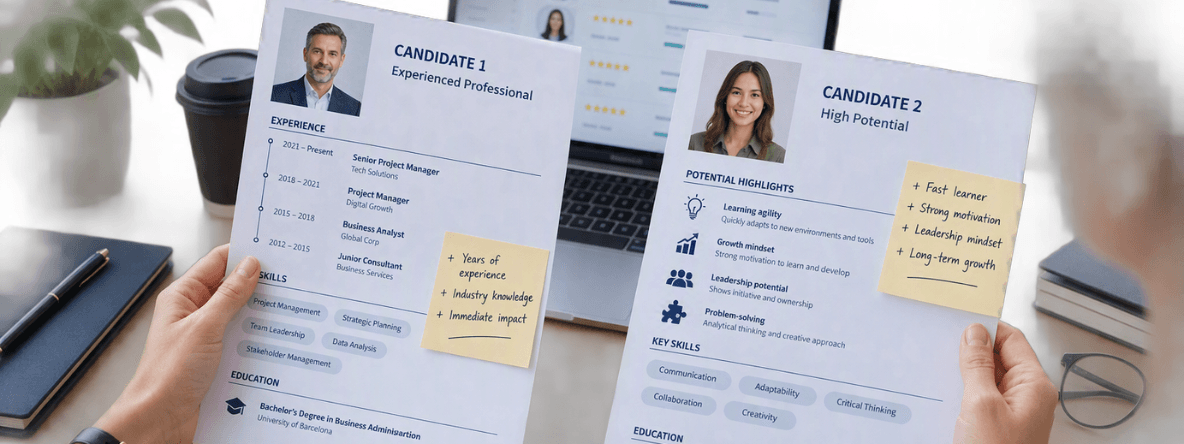
Professional experience allows candidates to demonstrate knowledge gained through real-world work situations.Experienced professionals often bring:
- Established technical expertise.
- Familiarity with similar responsabilities.
- A shorter learning curve.
- The ability to handle challenges from day one.
- Greater autonomy in their role.
For this reason, experience continues to be a key consideration, particularly for positions that require specialized knowledge or immediate impact.
What do we mean by potential?
Potential refers to a person's ability to learn, grow, and take on new responsibilities over time.It is not only about what a professional can do today, but also about what they may be able to achieve in the future.Some characteristics commonly associated with high potential include:
- Learning agility.
- Adaptability.
- Curiosity.
- Critical thinking.
- Problem-solving skills.
- Strong motivation for professional growth.
These qualities are particularly valuable in environments that are constantly evolving.
Why are companies paying more attention to potential?
Digital transformation, emerging technologies, and changes in the labor market have increased the need for professionals who can adapt quickly.In many cases, technical skills can be developed through training, while competencies related to mindset, attitude, and learning ability are often more difficult to teach.As a result, many organizations now consider potential a critical element of their hiring strategies.
The benefits of hiring for potential
Greater adaptability
High-potential professionals tend to perform well in changing environments and show a stronger willingness to develop new skills.
Long-term development
Hiring for potential allows organizations to develop employees who align with future business needs and support long-term workforce planning.
Increased innovation
People with a growth mindset often bring fresh perspectives, challenge existing processes, and contribute innovative solutions.
Stronger employee engagement
When organizations invest in employee development, professionals are more likely to see opportunities for growth and build a stronger connection with the company.
The benefits of hiring for experience
Faster integration
Professionals with relevant experience often require less time to adapt to the role and its responsibilities.
Specialized knowledge
For certain positions, industry expertise or technical knowledge may be essential to ensure strong performance from the outset.
Reduced initial training needs
Experienced employees often need less onboarding and technical training before becoming fully productive.
So, which is more Important?
The reality is that there is no universal answer.The importance of experience versus potential depends on factors such as:
- The type of role.
- Business objectives.
- The technical complexity of the position.
- Company culture.
- Future organizational needs.
While some roles require prior experience to deliver immediate results, others may benefit from professionals with strong growth potential and long-term development capabilities.
How to assess potential during the hiring process
Identifying potential requires looking beyond a candidate's CV.Some useful approaches include:
- Assessing learning agility.
- Exploring examples of adaptability in previous experiences.
- Discussing how candidates have handled professional challenges.
- Evaluating problem-solving abilities.
- Understanding their motivation and career ambitions.
Competency-based interviews and situational assessments can provide valuable insights into a candidate's potential.
The balance is the key to success
The most successful organizations rarely choose between experience and potential. Instead, they seek to combine both strategically.Experience provides knowledge and stability, while potential helps build teams that can evolve, innovate, and meet future challenges.A balanced hiring approach enables better decisions that support both current business needs and future growth.
ConclusionThe debate between hiring for experience or potential is not about determining which is better. Rather, it is about understanding what an organization truly needs at a given moment.Companies that can recognize both what a candidate has already achieved and what they may be capable of achieving in the future are better positioned to build stronger, more adaptable, and future-ready teams.